
Samia Halaby
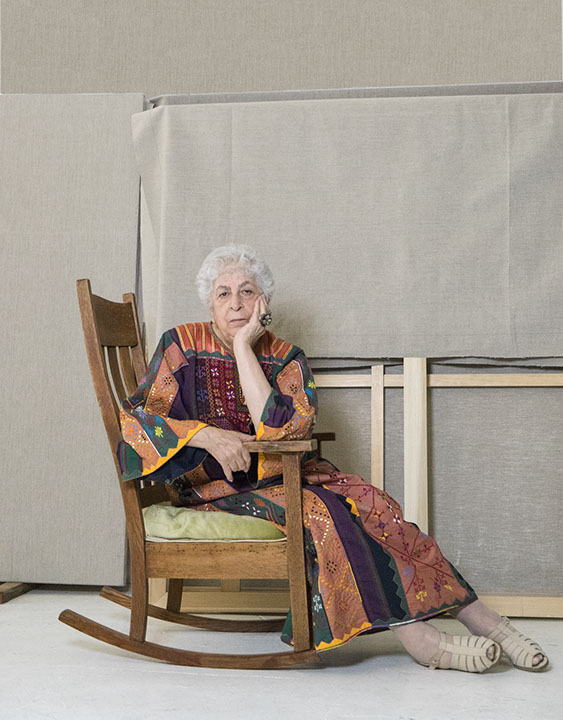
Samia Halaby (b.1936 in Jerusalem) is a Palestinian-American artist, and scholar living and working in New York.
Halaby was born in Jerusalem in 1936, during the British Mandate of Palestine. In 1948, Halaby and her family fled their home in the port city of Yafa with the creation of the Israeli state. She was 11 years old. Her family fled to Lebanon, residing in Beirut until 1951, when they eventually settled in Cincinnati, Ohio.
Halaby is a painter who was educated in the 1950s in the American Midwest, at a time when abstract expressionism was popular. While her work is very much in line with American art movements she evolved with, it is consciously enriched by the history of pictorial expression worldwide. Her oeuvre is today central to the study of abstraction within both global and Arabic visual language.
In her practice, she pays special attention to how we see our surrounding while moving, how surfaces seem to expand and contract as we pass them on the street, how we react to sudden noises that capture our full attention. Several paintings contained her experience contemplating the whirling motion of snowflakes out her window animated by the cross drafts between tall buildings.
In the mid-1980s, her time as a visiting artist at the University of Hawaii marks a turning point in her exploration of motion. The constant flux she tries to capture on canvas pushes her to break free from the traditional rectangular fabric. Playing with time, space, and movement in her work, she produces large installations that extend beyond the canvas edges, shaped and cut-out canvases, three-dimensional mobiles, and unconventionally large paintings that force the viewer to walk alongside them. At the very beginning of the digital, using the most advanced tools available to her at the time, Halaby teaches herself coding, and starts in 1986 to program kinetic paintings on an amiga computer, even coding sound into several. These experimentations with computer-generated visuals naturally evolve into the Kinetic Painting Program, through which she transforms the keyboard of her PC into a live digital painting instrument.
In over six decades Halaby has produced an immense body of work and is a very particular, innovative figure within her generation of artists. Understanding what parts of a painting the eye will first see, and how our mind will record the visual, she constantly foregrounds works and techniques and, in retrospect, was at the avant-garde of artistic production throughout her career.
As an independent scholar she has contributed to the documentation of Palestinian art of the twentieth century. Her writings on art history, pedagogy, and aesthetics have also appeared in numerous publications over the last three decades. As an educator, Halaby introduced a groundbreaking undergraduate studio art program to art departments throughout the Midwest, and was the first full-time female associate professor at the Yale School of Art for nearly a decade. A New York-based advocate, Halaby has also been organizing for causes concerning class, race, and Palestine since the 1970s.
In 2025, Samia Halaby was honored with the MUNCH Award for artistic freedom. In 2024, the jury of the Biennale Arte in Venice awarded Halaby a Special Mention in recognition of her longstanding work.
Samia Halaby is represented by Sfeir-Semler Gallery Beirut / Hamburg.
 samia halaby